
Coolant Reservoir Low? What It Means and What to Do
A low coolant reservoir means the cooling system has lost fluid, and a healthy system should not lose any. Topping it off buys time, but a level that keeps falling points to a leak, even when the driveway stays dry. The fix is finding where the coolant goes before overheating does damage. At Coastal Ready Auto Repair, we come to your driveway or workplace in Baldwin and Mobile Counties to run that diagnosis, so you never have to tow the car or risk driving it hot to a shop.
TL;DR
Read the reservoir only when the engine is cold and the car sits on level ground. The level should fall between the MIN and MAX marks.
No puddle does not mean no leak. Coolant can burn in the engine, seep into the cabin or vaporize off hot parts.
Needing about a quart (1 liter) a month, or topping off every few weeks, means the system needs an inspection.
Add only the coolant type your manual specifies, premixed or a 50/50 blend, and only when the engine is cold.
If the temperature gauge climbs, steam appears or the warning light comes on, stop driving and call for help.
Table of Contents
How to read the coolant reservoir correctly
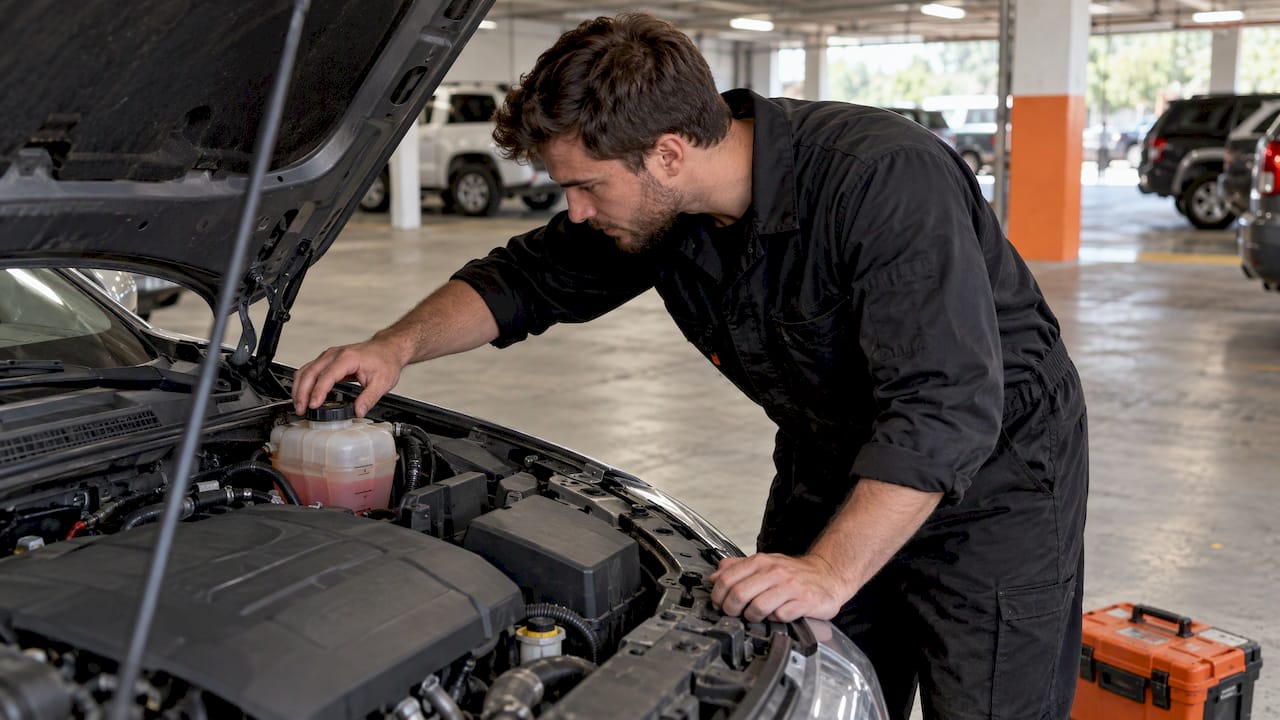
The reservoir (also called the overflow tank, recovery bottle or surge tank) is the translucent plastic tank near the radiator. It has molded MIN and MAX lines. Those lines only mean something when the engine is cold.
Ford’s owner manual says to check coolant only when the engine is cold and keep the level between MIN and MAX. It also warns that hot coolant expands and can rise above MAX. The 2022 Ram 2500/3500 manual gives the same rule for its pressurized bottle: between MIN and MAX when cold, and do not overfill.
So the answer to “MIN or MAX?” is anywhere between them, cold. It does not need to touch MAX. A reading below MIN on a cold engine is the signal that fluid is missing.
A practical routine:
Park on level ground and let the engine sit for several hours, ideally overnight.
Look at the tank from the side with a flashlight. Do not open the cap yet.
Note the level against the marks. Take a phone photo so you can compare next week.
Check again after a week of normal driving, always cold.
That photo log matters. Whoever diagnoses the car will want to know whether you lost a little or a lot, and how fast.
Why the level drops when there is no puddle
A dry driveway rules out only one thing: an external leak big enough to drip. Several other paths remove coolant without leaving a mark.
Small external seeps that evaporate
A pinhole in a hose or a weeping gasket on a hot engine can vaporize coolant before it reaches the ground. A report on hidden coolant loss describes how these seeps can drain a system steadily over weeks with no trace below the car. Trade publication MOTOR adds that reservoir seam leaks can run along the body and evaporate, and that tight, hot engine bays, especially turbocharged ones, can evaporate fluid from the overflow vent. Look for crusty white, green or pink residue around hose clamps, the radiator seams, the water pump and the reservoir.
A weak radiator cap
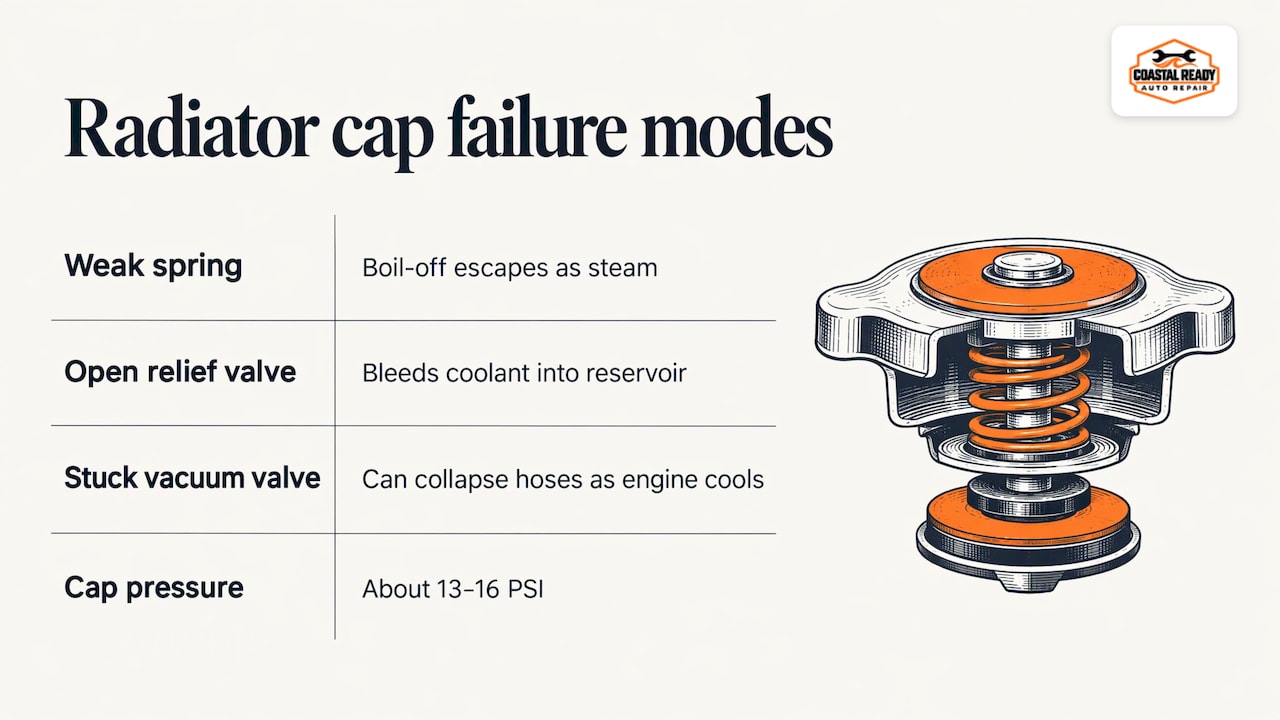
The cap holds the system at about 13 to 16 PSI, which raises the coolant’s boiling point. When the seal or spring weakens, coolant boils at a lower temperature and leaves as steam through the overflow tube, according to the same hidden-loss report. The cap has two valves: a pressure relief valve and a vacuum valve. A technician training lesson explains that a weak spring causes boil-off loss, a stuck-open relief valve bleeds coolant into the reservoir constantly, and a stuck vacuum valve can collapse hoses as the engine cools. Which valve failed changes the diagnosis, which is why a pressure test beats guessing.
Heater core leaks
The heater core is a small radiator behind the dash that warms the cabin. When it leaks, coolant ends up inside the car. Typical signs include:
A sweet smell inside the cabin, stronger with the heat or defroster on
A greasy film on the inside of the windshield that smears when wiped
Damp passenger-side floor mats
Weak or cold air from the vents
If the carpet under the passenger footwell is damp and smells sweet, that is where your coolant went.
Internal engine leaks
This is the one that matters most. Coolant can pass a failing head gasket into the combustion chamber, where it burns and exits through the exhaust, or into the oil passages. Signs of an internal leak include milky or frothy oil on the dipstick, thick white sweet-smelling exhaust smoke that continues after warm-up, bubbles in the reservoir at idle, and overheating. A small breach may burn coolant with no visible smoke at all.

The milky oil is the same thing people mean when they ask about water in the engine. Coolant (or water) mixed into oil turns it tan, gray or foamy, and oil in that state no longer protects the bearings. Our guide to white smoke from the exhaust walks through what the smoke tells you.
Is some coolant loss normal?
Very little. Most manufacturers consider a drop of up to about half an inch in the reservoir over 12 months acceptable, mostly minor evaporation through the overflow system, according to The Car Buzz. It also says topping up more than once every few months, a drop within days or weeks, or a drop that accelerates is not normal.
The owner manuals set the practical line. Ford says to have the vehicle checked if it needs more than 1.1 quarts (1 liter) a month. The 2026 Genesis manual likewise says to seek an inspection if frequent additions are needed.
This answers a common question: is it normal to add coolant every month? No. Adding monthly is the pattern of a slow leak, and slow leaks tend to get faster.
Low right after a repair or coolant service
A drop in the days after a coolant change, hose replacement or other cooling work can be air working its way out. Trapped air can work out and the level can fall to take its place, so one small drop after service is not alarming. Top it off cold to the marks, then watch.
What is not normal is a level that keeps falling after the air should have cleared. GM documented the problem on 2017 and 2018 Silverado and Sierra L5P diesel trucks in a January 2018 service bulletin. It lists a coolant leak, air left in the system and air from a prior engine repair as causes of a constant low-coolant message, and it calls for a 12-hour cold-soak pressure check and a vacuum fill procedure. The lesson applies to any vehicle: air in the system and a real leak look alike at first, and the cure for each is different. The pressure check and a proper vacuum fill separate them.
Reservoir empty but the radiator looks full
This usually confuses people. The system is designed so that as the engine cools, vacuum pulls coolant back from the reservoir into the radiator. If the reservoir is empty and the radiator is full, the recovery is not working as designed, or the reservoir has been boiling over.
On recovery-bottle systems, a low radiator with coolant in the bottle can point to a failed cap seal, a damaged filler neck, a leaking or blocked return hose, or a leak that stops vacuum recovery. Ram’s manual adds that the radiator normally stays full without routine cap removal, so the reservoir is the place to check.
If the tank is completely empty, Honda says to check the radiator too, but only after the engine and radiator are cool.
Safe top-off: what to add and when
If the level is below MIN and you need to drive, a careful top-off is reasonable.
Wait until the engine is fully cold. A hot cooling system is pressurized, and opening the cap can spray scalding coolant. Ford’s manual says not to remove a hot pressurized cap. Our partners at a collector-car storage facility cover cold-engine checks before opening the radiator cap in their inspection routine, and the same discipline applies in your driveway.
Use the coolant your manual specifies. Ford says to use prediluted coolant meeting the specification and not to mix coolant colors or types. GM’s guidance, per MOTOR, is to top up only with premixed coolant and distilled or deionized water to prevent corrosion.
Never add plain water or straight antifreeze. Honda says to raise the level at or below MIN up to MAX with a 50/50 coolant and water mixture.
Fill to the marks, not past them.
Write down the date and the amount you added.
There is no universal quantity. The cold marks and the specified coolant are the guide.
A top-off treats the symptom. If you have to repeat it, the next step is finding the leak, not buying more coolant.
When to stop driving
Stop and call for help if any of these happen:
The temperature gauge moves toward hot or the coolant warning light comes on
You see steam from the hood
The heater suddenly blows cold while the gauge climbs
Oil on the dipstick or under the filler cap looks milky
The reservoir is empty and you smell sweet coolant
Driving an overheating engine can warp the cylinder head and blow the head gasket, turning a hose repair into an engine repair. Pull over, shut off the engine, let it cool before opening anything, and do not continue to the next exit.
A related note from the same family of questions: if a car stalls in standing water, do not restart it. Water drawn into the intake can enter the cylinders, and cranking can bend internal parts. Have it moved and inspected, and keep the sequence of events in mind when you describe the stall, because milky oil afterward points to water entering the engine.
What a proper diagnosis involves
A good cooling system diagnosis does not start by swapping parts. It narrows the cause in this order:
Visual inspection of hoses, clamps, radiator, water pump area and reservoir for residue and seepage
Cold pressure test of the system, which forces a slow leak to show itself
Cap test to see whether the cap holds its rated pressure
Heater core and cabin check for damp carpet, fogged glass and odor
Combustion leak check to see whether exhaust gases are entering the coolant, along with an oil inspection
Scan for stored codes when a warning light or check engine light has come on
The Car Buzz puts a cap pressure test at $0 to $20 and a replacement cap at $10 to $25, so that is the cheap place to start before assuming the worst. Our Diagnostics & Warning Lights service uses advanced diagnostic tools to identify the issue, and if the trouble turns out to be inside the engine, we also handle engine repairs.
One caution from MOTOR: extended-life coolants mean fewer inspections, which gives leaks time to develop at heater cores, gasket joints and water-pump seals. A seep at a water-pump weep hole can also be normal, since that is the coolant’s exit path for lubricating the seal. That is the sort of judgment call a technician makes on the car, not from a photo.
Keeping it cheap: acting early
A hose or cap caught early costs little. A head gasket caught after repeated overheating costs far more. The signs that raise the stakes are the same each time: a level that falls on a schedule, a sweet smell, a fogging windshield, white smoke or milky oil. If you see any of them, book the inspection. If your reservoir is the only symptom and you are within a quart a month, keep your photo log and re-check cold weekly.
In the Gulf Coast heat around Mobile and Baldwin Counties, with stop-and-go traffic and long summer AC use, the cooling system works hard. Many drivers notice a falling coolant level in the same season they first feel weak air conditioning. The two systems share the front of the car and the airflow, so if your AC is also struggling, see our notes on a car AC that is not cold.
Have the diagnosis come to you
Our technicians work at your home, office or wherever the car is parked in Baldwin and Mobile Counties. For a coolant level that keeps dropping, that means a vehicle that stays parked and cold, which is how the cooling system is best inspected, with no towing and no hot drive to a shop. We keep you informed about what we find and what the repair involves before work begins. Start with Diagnostics & Warning Lights, or reach us through Coastal Ready Auto Repair.

If the engine is already running hot, tell us when you book so we can prioritize it.
Our view on a falling coolant level
Most drivers who call us about low coolant have already topped it off once or twice. That is a sensible first move, and we would never fault anyone for it. The trouble starts when the top-off becomes a habit, because the level is the only warning the cooling system gives before the temperature gauge does. We built our service around the idea that the car should not have to move to be understood. A cold engine in your driveway is the best condition for finding a slow leak, checking a cap and looking over hoses and the area around the water pump. Warning lights and stored codes add to the picture, and our diagnostic tools help us tie them to a cause rather than guess. Our advice is simple. Keep the cold-level photo, use the coolant your manual names, and when the level keeps dropping, have it looked at while the fix is still small. We would rather talk it through with you early than meet you on the shoulder. Gabe
FAQ
Why is my coolant low but there is no leak?
No puddle only rules out a drip. Coolant can burn inside the engine, seep into the heater core, boil off through a weak radiator cap or vaporize from a small seep on a hot part. A cold pressure test and cap test are the usual ways to find it.
Is it normal to add coolant every month?
No. A healthy cooling system should not need regular additions. Ford’s manual says to have the vehicle checked if it needs more than 1.1 quarts (1 liter) a month, and a drop within days or weeks deserves attention sooner.
Should I fill the coolant to MIN or MAX?
With the engine cold, keep the level between the two marks. If it is at or below MIN, bring it up toward MAX with the coolant type your manual specifies, premixed or a 50/50 blend, and do not overfill.
Is it safe to drive with the coolant reservoir low?
Short, careful trips are possible if the gauge stays normal and you top off cold first, but the cause still needs finding. Stop driving at once if the temperature gauge rises, steam appears or the warning light comes on, since overheating can cause severe engine damage.
Recommended

