
Timing Belt vs. Chain: Lifespan, Cost and Warning Signs
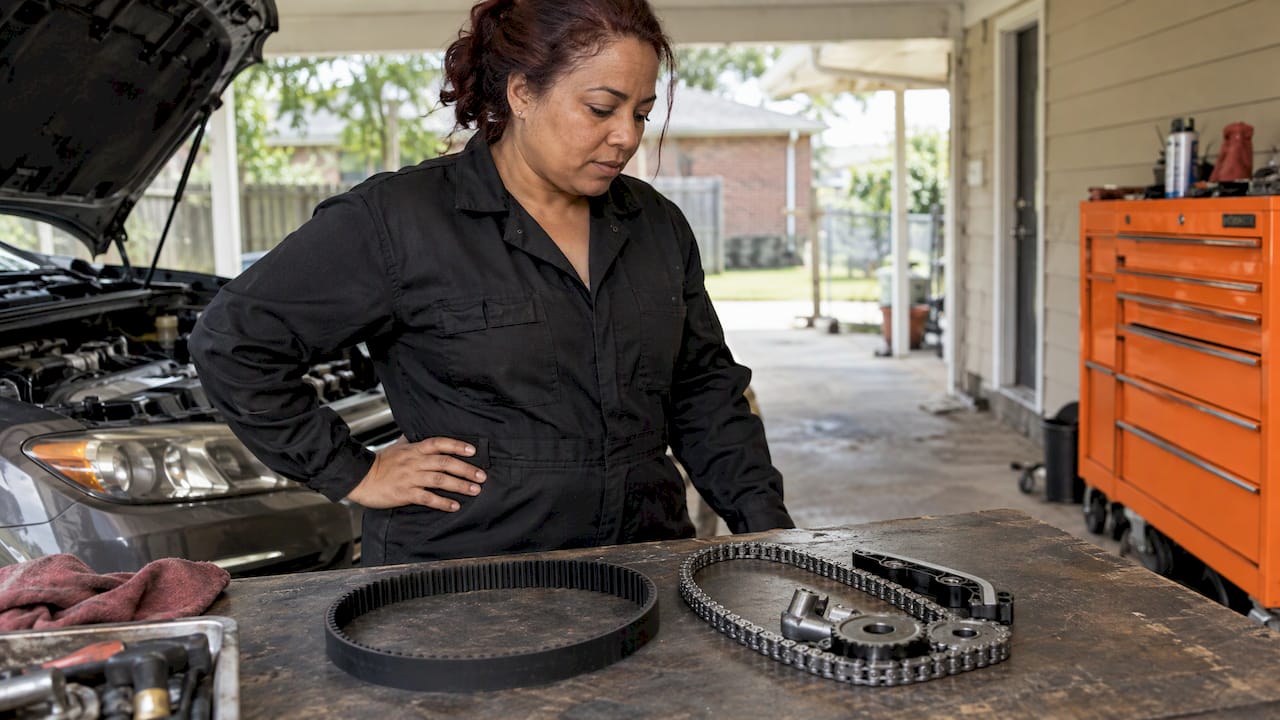
A timing belt is a rubber part that usually has a replacement deadline. A timing chain is a metal part that often has none, but it still depends on clean oil and healthy tensioners. Which one your engine has decides what maintenance you owe it, what a failure costs, and which warning signs matter. If you are in Baldwin or Mobile County and your car is rattling, throwing a code or nearing a belt deadline, we can diagnose it at your home or workplace, with no tow to a shop.
TL;DR
Belts are rubber and are replaced on a schedule, commonly somewhere between 60,000 and 120,000 miles depending on the engine. Chains are steel and often last the life of the engine.
Your owner’s manual settles the question: if its maintenance schedule lists a timing belt replacement, your engine has a belt.
A belt job typically costs less than a chain job, but a chain job is rarer. A snapped belt on an interference engine can cost far more than either.
Chains live on oil. On-time oil changes are the best protection you have.
A rattle on cold start, misfires or timing-related codes deserve a diagnosis soon, not after the next road trip.
Table of Contents
What the timing belt or chain actually does
Your engine has a crankshaft, driven by the pistons, and one or more camshafts, which open and close the valves. The timing belt or chain links them so the valves open at exactly the right moment. Toyota’s maintenance guide describes it the same way: the belt or chain drives the camshaft and controls when the valves open.
The difference is material and location:
Timing belt: reinforced rubber, running dry outside the main engine block. It is lighter, quieter and cheaper to build, which is why many automakers have used it. AutoZone’s guide notes that oil contact damages a belt.
Timing chain: steel, running inside the engine and lubricated by engine oil. J.D. Power points to the material as the reason chains typically outlast belts.
An engine is designed around one or the other. You cannot swap a belt engine to a chain, so the real question is never which is better in the abstract. It is what yours needs.
How to find out which one your car has
Start with the owner’s manual. Chevrolet’s own maintenance page lists timing belt replacement in its 90,000-plus-mile service tier for applicable vehicles and sends owners to the Owner’s Manual for the schedule that fits their exact vehicle. If a belt replacement shows up in your schedule, you have a belt. If it never mentions one, you very likely have a chain.
Two more clues:
Many engines with a belt have a plastic cover on the side of the engine. Chains sit behind a metal cover bolted to the block, and you cannot see them without taking the engine apart.
The same model can change between generations. A 2012 version and a 2018 version of a car may have different setups, so look up your specific year, engine and trim.
If the manual is missing, the VIN and the engine size are what a technician uses to look it up. That is a quick check when we are already looking at your car.
When to change a timing belt
No single number fits every car. Published ranges differ because engines differ:
Consumer Reports lists a belt interval of 60,000 to 120,000 miles.
AAA lists 60,000 to 100,000 miles and points to your owner’s manual as the most accurate source.
Many schedules also carry a time limit, because rubber ages even when the car sits. A typical pattern is a mileage figure or a number of years, whichever comes first. Our Gulf Coast heat and humidity are a reason to take the time limit seriously rather than treating it as fine print.
A belt can look fine and still be near the end of its life, since the failure is in the fibers inside. Do not stretch the interval because a visual check looked good. Treat the number in your manual as a deadline.
What usually gets replaced with the belt
Belt jobs commonly include the tensioner and pulleys, and on many engines the water pump, since they sit behind the same covers and the labor overlaps. Ask for the full list when you get an estimate so you compare like with like.
What a timing chain needs
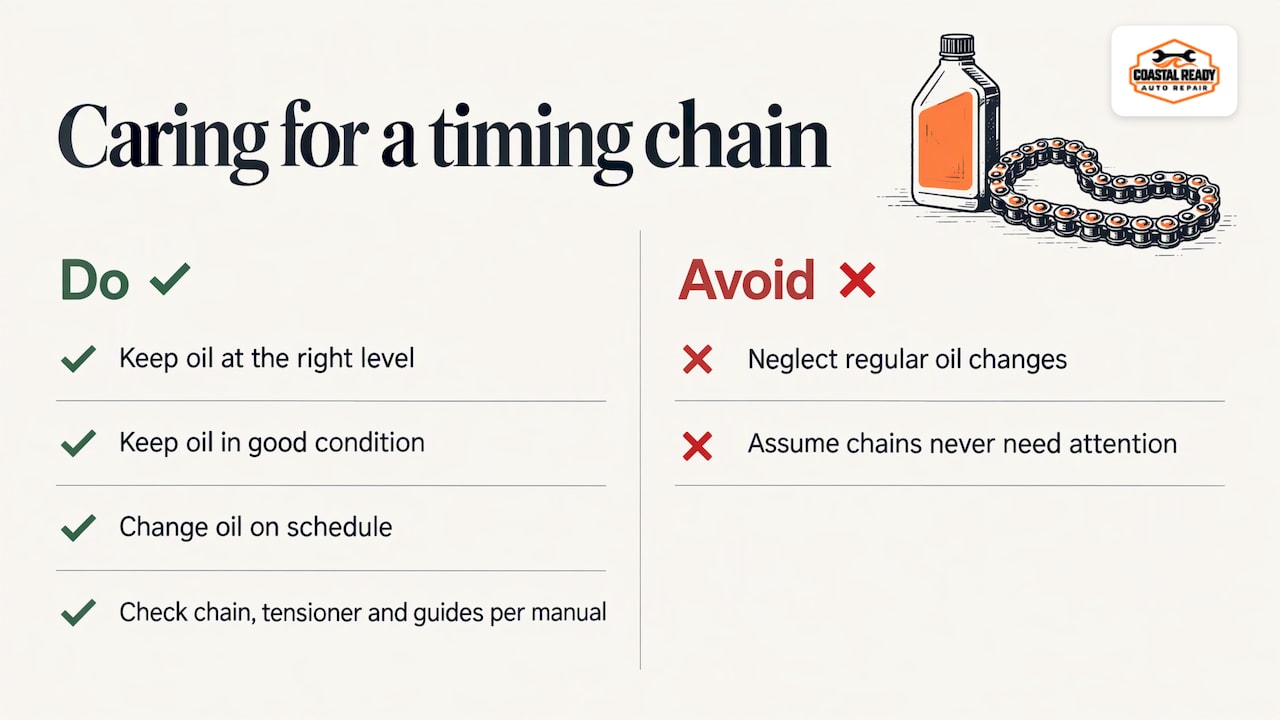
Chains are often called maintenance-free, and that is close but not exact. Honda’s own knowledge page says a chain generally needs no scheduled replacement, yet inadequate engine maintenance can cause it to stretch or skip a position. Its advice is to keep the oil at the right level and condition, and to check the chain, tensioner and guides at the intervals your manual gives.
Engine Builder Magazine ties chain wear directly to oil condition: worn oil does not protect the chain well. Empire Auto Protect reports that on-time oil changes support chain lives of 250,000 miles or more, while chronic neglect can cut that to a range of 80,000 to 150,000 miles.
That makes the oil change your timing chain service. If you are unsure how often your engine really needs one, our guide to the oil change interval walks through it, and our oil change and maintenance service comes to your driveway.
Chains are not invincible. Cars.com points out that tensioners and guides can wear, and that chain replacement can cost more than a belt replacement. Longevity is typical, not guaranteed.
Warning signs of a worn chain or belt
A chain usually gives notice before it fails. A belt often gives much less. Watch for:
A metallic rattle for the first few seconds after a cold start that fades as the engine warms. This is a classic sign of a worn tensioner.
Misfires or a rough idle. If the timing slips, combustion goes off. Our article on misfire symptoms explains what the engine is telling you, and a car that shakes at idle has its own set of causes.
A check engine light with timing codes. Codes in the P0016 to P0019 family relate to crankshaft and camshaft correlation. They can also come from cheaper problems such as oil pressure, a cam sensor or a variable valve timing solenoid, which is why a proper diagnosis comes before any decision to open the engine. See what the check engine indicator light means for the first steps.
Hard starting, ticking from the front of the engine, or oil leaking near the timing cover.
On a belt: cracks, fraying or glazing if the cover is off, and squeaking from the tensioner or pulleys.
If the check engine light is blinking, that points to an active misfire that can damage the engine and exhaust. Read what to do right now and slow down or stop driving.
Brake and other wear items on the same visit
A timing repair tends to be a major job, and it is a sensible moment to look at the rest of the car. Knowing the brake pad wear signs lets you raise anything you have noticed, such as squealing or a longer stopping distance, so it gets handled in the same appointment.
Why a broken belt can be so expensive
Many engines are called interference engines. In these, the valves and pistons occupy overlapping space at different moments, and the timing keeps them apart. If a belt breaks while you drive, the valves can stay open as the pistons come up and strike them. Toyota’s guide says that interference engines with rubber belts can suffer catastrophic damage if the belt breaks while driving.
That is the logic behind following the interval. Replacing a belt on schedule is a planned expense. Replacing it after it breaks on an interference engine can mean bent valves or worse. A failing chain tends to be more gradual, with rattling, misfires and codes arriving first, so you often get a chance to act.
What each repair costs
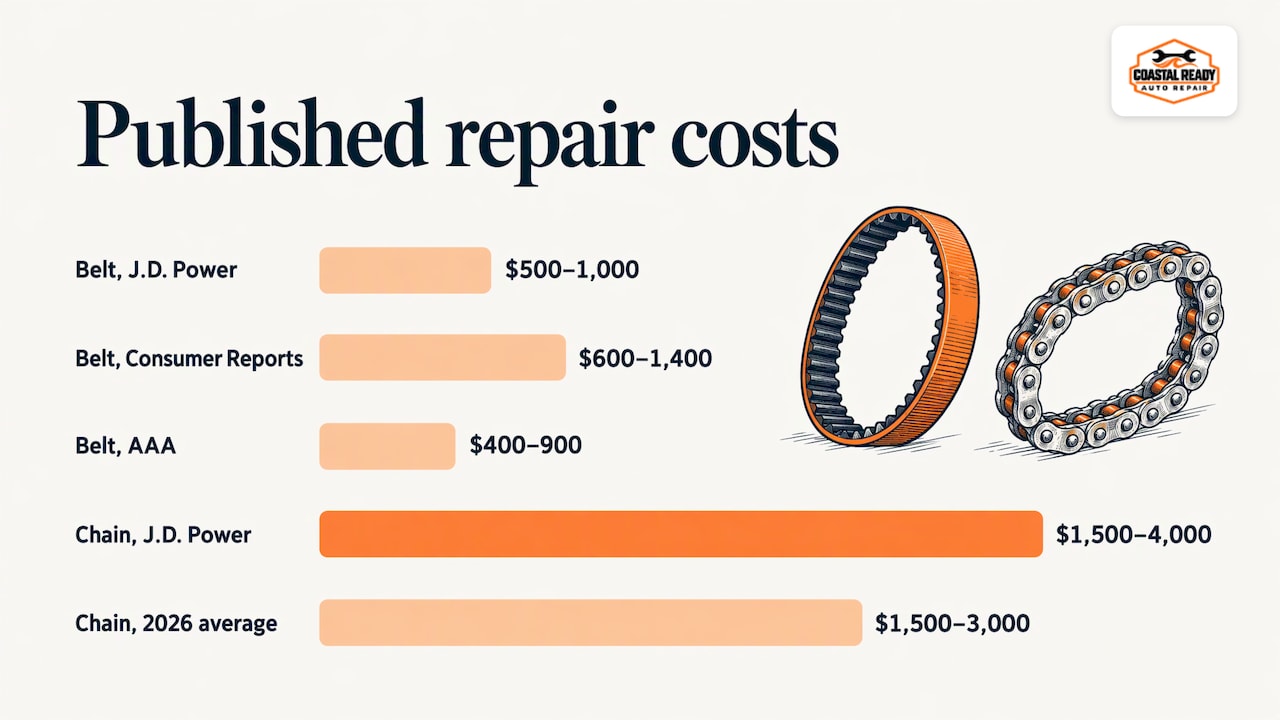
Published ranges vary by vehicle, labor rate and what is bundled in the job, so treat them as orientation, not a quote.
Item | Published range | Source |
Timing belt replacement (typical) | $500 to $1,000 | |
Timing belt replacement | $600 to $1,400 | |
Timing belt replacement | $400 to $900 | |
Timing chain replacement | $1,500 to $4,000 | |
Timing chain replacement, 2026 average | $1,500 to $3,000, with complex V6 and V8 engines at $3,500 or more |
A belt is the cheaper job each time you do it. A chain is the costlier job but is needed far less often, and many chains never need one. Chain work costs more mostly because of labor: the chain sits deep inside the engine, so more has to come apart to reach it.
Over the life of the car, the comparison is less clear-cut than the price tags suggest. A belt engine might need one or two belt jobs. A chain engine, kept on a regular oil schedule, might need none.
Which is better for you?
It depends on what you already own.
If your car has a belt, the answer is to follow the interval. Know the mileage and the age limit, and schedule the job before either arrives.
If your car has a chain, the answer is oil. Change it on time, use the grade your manual calls for, and have unusual noises looked at early.
If you are shopping for a used car, ask for the maintenance records. On a belt car, a documented belt replacement near the interval is worth more than a low odometer. On a chain car, a record of regular oil changes matters most.
Belts are quieter and cheaper to build, and chains typically last longer. Neither is a flaw. Each is a trade the engineers made, and each asks for different care from you.
We come to you for the diagnosis and the repair
If you hear a rattle, see a warning light or are not sure whether your belt is due, the first step is knowing what is actually wrong. Our diagnostics and warning light service uses advanced diagnostic tools to find the cause, so a cheap sensor problem is not mistaken for a chain problem. If the engine needs work, our engine repairs are done at your location in Baldwin and Mobile Counties, so you do not have to arrange a tow or wait at a shop.

We also keep you informed about the repair and the appointment, so you know what is needed before work begins. You can start on our home page or go straight to the service that matches your problem. We serve areas including Mobile, Foley, Spanish Fort and Orange Beach.
Our view on timing work
The timing question is really a planning question. A belt is a known date on the calendar, and a chain is a long-term bet on how well the oil has been looked after. Either way, the owners who spend the least are the ones who find out early. What we like about mobile service here is the time it saves. A rattle on cold start or a check engine light is easy to put off when it means arranging a tow or giving up a workday. When the diagnosis comes to your driveway, you can act while the problem is small. Our approach is built on clear communication: you know what we found, what it means for your car and what the next appointment looks like. If you do not know which setup your engine has, or when your belt is due, ask us. We will help you work it out and plan around it, so the repair is on your schedule and not the engine’s. Gabe
FAQ
Which is better, a timing belt or a timing chain?
Neither wins in every case, because each engine is designed for one. Chains typically last longer and often need no scheduled replacement, while belts are quieter and cheaper to build and replace. What matters is following the care your engine’s setup calls for.
How often should I change my timing belt?
Published ranges run from about 60,000 to 120,000 miles, and many schedules add a time limit in years. Your owner’s manual gives the exact figure for your engine, and AAA also points owners to it. Do not extend the interval because the belt looks fine.
How do I know if my car has a timing chain?
Check the maintenance schedule in your owner’s manual. If it lists a timing belt replacement, your engine has a belt, and if it does not, it most likely has a chain. A chain sits behind a metal cover, so you cannot see it without opening the engine.
What are the disadvantages of timing chains?
Chains are louder than belts, and their tensioners and guides can wear. Their lifespan depends on clean oil, and replacing one costs more than a belt job because of the labor involved. Regular oil changes and attention to a cold-start rattle keep most chains in good shape.
Is it more expensive to replace a timing belt or a timing chain?
A chain job costs more. J.D. Power cites $1,500 to $4,000 for a chain and $500 to $1,000 for a belt. Chains need replacing far less often, and many never do.
Recommended

